.avif)


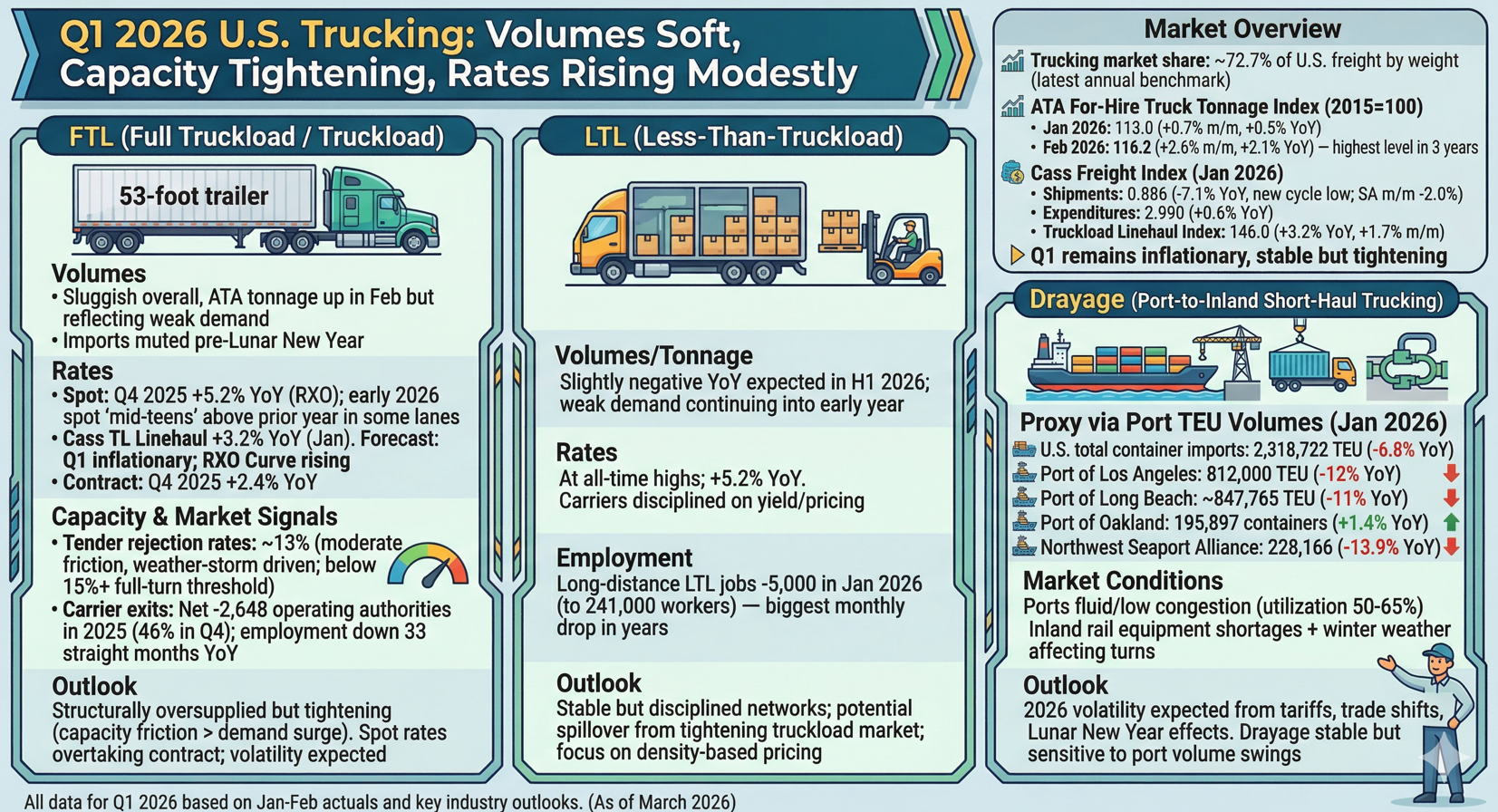
As we close the books on the first quarter of 2026, the U.S. domestic transportation landscape presents a complex, rebalancing act. Navigating this environment requires shippers to look beyond surface-level headlines and dive into the granular data driving the market. Based on an analysis of January and February actuals combined with Q1 outlooks from major industry bellwethers including the ATA, Cass Information Systems, and major port authorities the definitive theme for Q1 2026 is: Volumes Soft, Capacity Tightening, Rates Rising Modestly. While overall demand remains historically sluggish, structural shifts in carrier availability are beginning to apply upward pressure on pricing across FTL services, LTL, and specialized segments. Here is a detailed breakdown of the critical metrics defining the trucking company USA market in Q1 2026.

The Macro View: Market Share and Key Indices
Trucking remains the dominant force in American logistics, commanding approximately 72.7% of U.S. freight by weight, according to the latest annual benchmarks. Understanding the health of this sector is vital for broader economic forecasting.
Data from Q1 2026 reveals a divergent narrative between physical tonnage and transactional volume:
- ATA For-Hire Truck Tonnage Index: This key volume proxy showed surprising strength in February, increasing +2.6% month-over-month and +2.1% year-over-year. This pushed the index to 116.2 (2015=100), its highest level in three years.
- Cass Freight Index (Shipments): Conversely, the Cass Shipment Index for January hit a new cycle low, dropping -7.1% year-over-year.
The Synthesis: The market is "stable but tightening." While seasonal weakness and soft final demand persist, specific factors—including severe winter weather in Q1 and, crucially, capacity attrition—are compressing the available market. The Cass Freight Index for Expenditures reflects this, rising +0.6% YoY, indicating that even with fewer shipments, the total cost of transportation is ticking upward.
FTL Services (Full Truckload): The Epicenter of Tightening
For shippers utilizing FTL services, the primary story of Q1 2026 is the erosion of carrier supply. After a prolonged downcycle, the structural oversupply in the truckload market is finally reversing.
Volumes and Utilization
Overall truckload volumes remained sluggish through the quarter. This was compounded by muted imports ahead of the Lunar New Year, which traditionally drives significant FTL demand from port areas to inland distribution hubs.
Capacity and Market Signals
This is where the true market shift is occurring. The industry witnessed massive carrier attrition leading into 2026. Data confirms a net exit of -2,648 operating authorities in 2025, with a significant 46% of those exits occurring in Q4 alone. Furthermore, industry employment has dropped for 33 consecutive months year-over-year.
This capacity right-sizing, combined with disruptive winter storms, drove tender rejection rates to approximately 13%. While this remains below the 15%+ threshold that signal a complete market turn, it represents moderate friction and a significant increase from the lows of 2024/2025.
Rates Outlook The logical consequence of tightening capacity is rising rates. Spot Market: After increasing +5.2% YoY in Q4 2025, early 2026 data shows spot rates reaching "mid-teens" percentage gains above the prior year in some specific lanes. Contract Market: Contract rates lagged, up only +2.4% YoY in Q4 2025. FTL Outlook: We expect a period of increased volatility. As spot rates overtake contract rates in more markets, carriers will prioritize spot freight, leading to higher contract tender rejections in Q2 and driving contract pricing higher later in the year.
LTL (Less-Than-Truckload): Disciplined Networks and Pricing
The LTL sector remains characterized by high carrier discipline. While FTL often behaves like a commodity market, LTL carriers have maintained a firm grasp on network utilization and pricing power.
Rates and Volumes
LTL rates started 2026 at all-time highs, increasing +5.2% year-over-year. Carriers remain intensely focused on yield management and density-based pricing models. However, demand has not yet caught up; tonnage is expected to remain slightly negative YoY through H1 2026.
Employment Shift
Perhaps the most notable metric in the LTL sector was employment. Long-distance LTL jobs dropped by 5,000 workers in January, bringing the total workforce to 241,000. This marks the biggest monthly drop in this sector in years, signaling network optimization as carriers adjust to the persistent weak demand environment.
LTL Outlook: Networks remain stable. Shippers should anticipate potential "spillover" from the tightening truckload market; as FTL carriers reject smaller loads, they may move back to LTL, tightening capacity further. We advise shippers to prioritize freight clarity and optimization to manage density-based pricing.
Drayage Services: Stability Amidst Port Volume Volatility
Drayage services—the critical short-haul connection between ports and inland networks—experienced a volume slowdown in Q1 2026, primarily driven by a drop-off from 2025 record highs.
Port Volume as a Drayage Proxy
January 2026 data shows a significant cooling of import activity:
- Total U.S. Container Imports: 2,318,722 TEU (-6.8% YoY from the 2025 record which was driven by tariff front-loading).
- Port of Los Angeles: 812,000 TEU (-12% YoY).
- Port of Long Beach: ~847,765 TEU (-11% YoY).
- Northwest Seaport Alliance (Seattle/Tacoma): 228,166 TEU (-13.9% YoY).
- Notable Exception: The Port of Oakland saw a slight gain of +1.4% YoY.
Market Conditions
Despite lower volumes, the drayage market faced operational challenges. Ports themselves remained fluid with low congestion and utilization rates of 50–65%, well below crisis levels. However, winter weather and shortages of inland rail equipment created "turns" friction, affecting efficiency.
Drayage Outlook: While currently stable, 2026 volatility is expected. Ongoing shifts in trade policy, potential new tariffs, and the lingering effects of the Lunar New Year slowdown (factored into Feb-Mar results) will keep this market sensitive to port volume swings.
Trust and Authority in Your Supply Chain
At LDP Logistics, we recognize that navigating the nuances of the domestic transportation market requires more than just reactive logistics, it requires proactive intelligence.
The Q1 2026 data highlights a crucial point: just because demand is low doesn't mean rates are staying low. Capacity is the ultimate driver, and right now, capacity is leaving the market faster than demand is returning.
As a premier logistics company USA partner, we are committed to using this data to help our clients build resilient strategies. Whether you require reliable FTL services amidst capacity crunches, optimized LTL solutions, or fluid drayage services, our expert teams are prepared to help you steer through the rebalancing market of 2026.
Contact LDP Logistics today to discuss how the data of Q1 2026 should shape your transportation strategy for the remainder of the year.
Disclaimer: All data presented for Q1 2026 is based on January-February actuals and established industry outlooks. Aggregated, official Q1 reports are pending release from primary sources (ATA, Cass, BTS) and may modify final quarterly totals.